

The Effect of Strikes on the Nigerian Economy
From times past, industrial strike has seemed to be the only way the to convince the Nigerian government to be reasonable and listen to the voice of the people, and such strike actions come from all sectors such as Health, Labour, Judiciary, Education and more. For how long will this be the only reason the government will want to compromise, forgetting that this has a major effect on the economy of this great Nation?
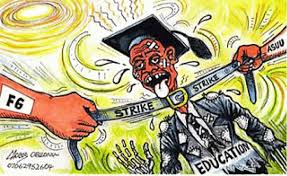
Though there may be genuine reasons for workers to embark on industrial strike action, the continuous strikes that take place in Nigeria are worrisome.
Economic experts say that if the incessant strikes are not checked, Nigeria’s aim to be among the top 20 economies by the year 2020 may not be realized.
Stakeholders who spoke on the backdrop of the current strike by members of the Nigerian Medical Association (NMA) and the Judiciary Staff Union of Nigeria (JUSUN), noted that most of the time workers’ strikes address welfare and other pecuniary issues. For example, what we are experiencing now in the Country: high fuel prices, an electricity tariff that has also risen even though there is no power, high costs of transportation and every other thing- yet salaries have remained the same.
A professor of Economics at the University of Abuja, Sarah Anyanwu, said that generally, incessant strikes have adverse effect on the economy. According to her, some of the effects are loss of national output, fall of Gross Domestic product (GDP) -which was recently re-based-, manpower loss and man-hour loss. She further said that the strikes in various sectors were having negative effects on the economy as they caused cost-push inflation and an increase in the poverty level.
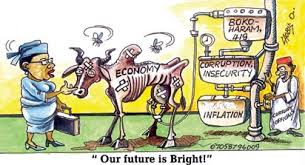
When there is strike, goods and services are not available, while demand remains high- this results in inflation. More so, the Foreign Direct Investment (FDI) is affected, because you will not retain the trust of investors if the system is not stable as a result of frequent strikes. Our developmental objective of being among the top 20 economies by 2020 will not be realized is there are reoccurring lulls in production of goods and services due to industrial actions.
According to Anyanwu, the loss of the lives of family bread-winners in the hospital due to a doctors’ strike causes poverty and puts additional pressure on families, society and the economy. She said that incessant industrial actions also increase political agitations as opposition politicians would always cash-in on such situations.
Mr. Emeka Oraba, a Social Commentator, said that growth and development, whether in the health, education or any other sector, is a continuous process. He said that the nation loses millions of naira in capital flight because of the rising number of Nigerians seeking admission in foreign schools and those seeking medical treatment abroad.
When an academic process gets interrupted with strike, all ongoing research get abandoned or delayed; students keep their books on the shelves and when the strike is called off, both students and lecturers are mentally weak. At the end of the day, students graduate with mere certificates instead of knowledge that could impact on the economy. Incessant strikes in our education sector have brought about an exodus of Nigerian students to universities in Ghana, South Africa, UK, U.S.A, India and even Malaysia.
Mr. Oraba additionally said that all efforts to curb medical tourism will be futile if the hospitals are always closed because of strike. According to him, even people who ordinarily will receive medical attention in Nigeria may be pushed into medical tourism; hence the loss of foreign exchange.
On the incessant strikes by members of the NMA and JUSUN, stakeholders want parties to come to amicable resolutions in order to avoid the loss of lives and denial of justice. Government hospitals are not functioning regularly, and meanwhile the courts are not sitting. “Where do they want somebody who has a bail application to go to when the courts are not sitting?”, a litigant who came to a Federal High Court in Abuja when the JUSUN strike started lamented.
Even though the amount of money lost as a result of the numerous strikes embarked upon by workers cannot be quantified, the amount lost during the 2012 petroleum subsidy strike was put at about N300 billion. The Minister of Finance, Dr. Ngozi Okonjo-Iweala, who gave the figure, said that the amount was not more than that only because the economy was not totally shut down during the six-day strike.
She said that if the economy was totally shut down, the country would have lost about N500 billion for the period the strike lasted. The amount quoted by the Minister to have been lost in only six days shows the adverse effect of incessant strikes on the national economy generally. Stakeholders want the government to do everything within its power to check incessant strikes, especially in key and critical sectors of the economy.